|
|
To loosely paraphrase Bob Dylan, the skies they are a-changin'.
This week, summer will fall behind us as the September equinox marks the start of astronomical autumn and the coming of longer, darker nights. We'll begin by hunting the light of an ancient star cluster near the stars of the constellation Cassiopeia, and seizing a brief window of darkness to hunt for zodiacal light before sunrise.
Later, we'll watch as Jupiter passes into the constellation Leo, before September's Harvest Moon rises to bleach the early autumn sky, casting a veil of moonlight thin enough to be pierced by the light of a majestic double star system in Aries.
Add to that a comprehensive guide detailing everything that you need to know about the total solar eclipse in August 2027, which is already being described as the "Eclipse of the Century", and we've got a pretty stacked week!
Wishing you clear skies,
Anthony Wood
Skywatching Writer, Space.com
|
|
 |
| (Jules-Pierre Malartre/Starry Night) |
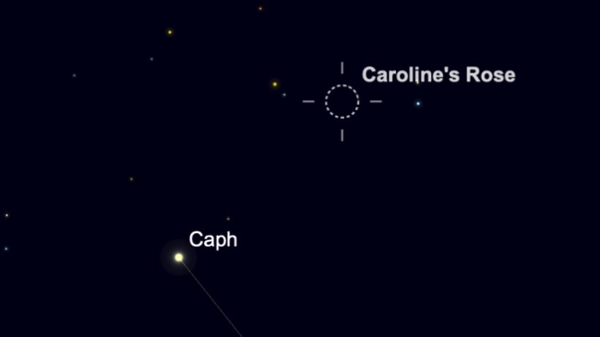
Look to the northeastern horizon after sunset for the "W" formation of stars in the constellation Cassiopeia glittering in the late summer sky, and pinpoint the variable star Caph, which will shine at its highest point for viewers in the Northern Hemisphere.
Grab your binoculars and scan the 3 degrees of sky surrounding Caph until you find a faint ball of light cast by the stars of the Caroline's Rose Cluster, also known as NGC 7789. An 8-inch telescope will help resolve hundreds of the gravitationally bound stars belonging to the cluster, which together are reminiscent of swirling rose petals glowing against the blackness of space.
|
|
 |
| (Jules-Pierre Malartre/Starry Night) |
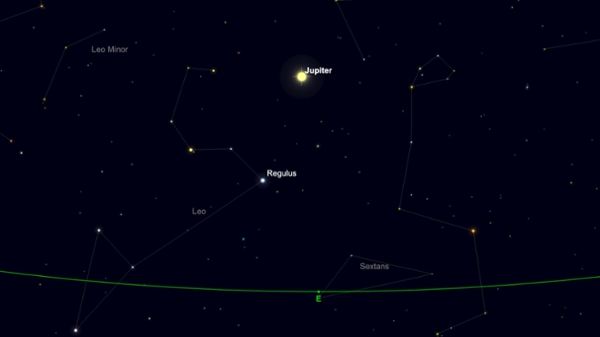
The September equinox occurs on Sept. 22 at 8:05 p.m. EDT (0005 GMT on Sept. 23) as the sun passes north to south across Earth's celestial equator, heralding the beginning of astronomical autumn for the Northern Hemisphere.
It's the perfect night to head away from city lights to hunt for zodiacal light, which appears as a pyramid of milky light in the eastern sky before dawn, as sunlight strikes dust particles scattered throughout the plane of our solar system. The waxing gibbous moon will set a few hours before sunrise, leaving a short, dark window in which to spot the elusive natural light show.
|
|
 |
| (Jules-Pierre Malartre/Starry Night) |
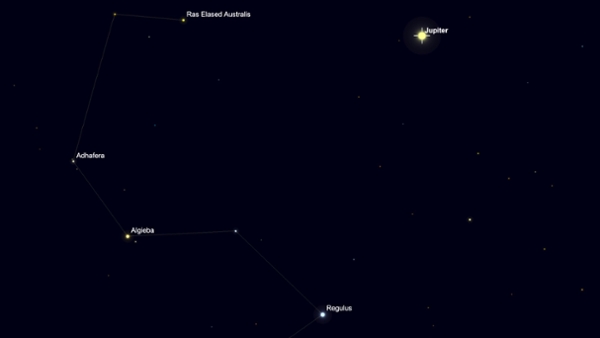
Jupiter officially enters the constellation Leo in the predawn hours of Sept. 24, having spent the first part of the year journeying through the starscapes of Gemini and Cancer.
Look for the steady light of Jupiter shining low on the eastern horizon in the hours preceding dawn, with the backward "question mark" of stars known as the Sickle of Leo nearby, anchored by bright Regulus.
|
|
 |
| (Jules-Pierre Malartre/Starry Night) |
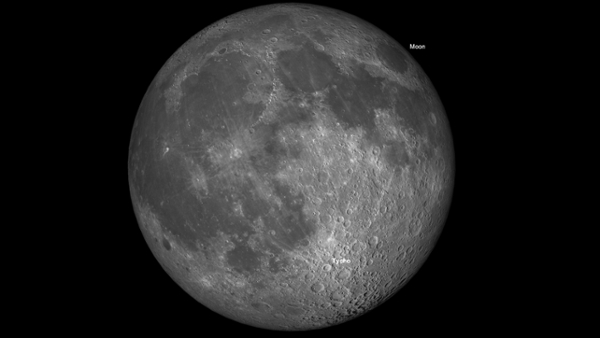
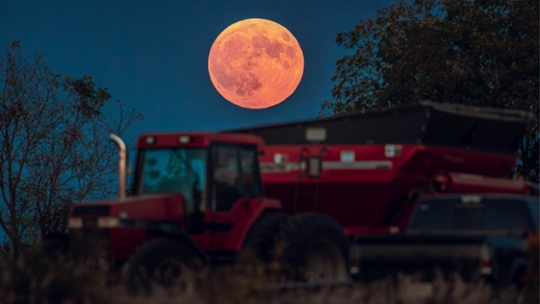
September's full Harvest Moon rises as the first full moon of autumn at sunset on Sept. 26. Viewers in the Northern Hemisphere will catch their first glimpse of the yellow lunar disk as it rises over the eastern horizon, with Saturn appearing as a brilliant star-like object below.
|
|
 |
| (Jules-Pierre Malartre/Starry Night) |
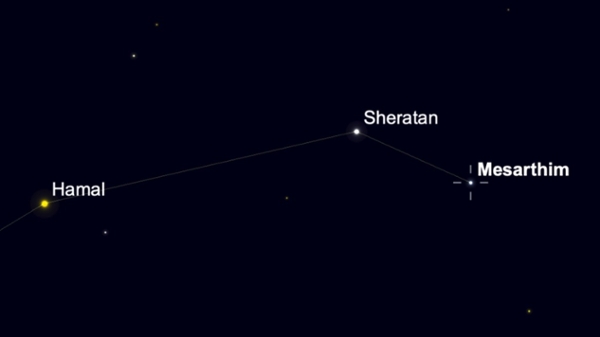
The glare cast by the near-full waning gibbous moon will make deep-sky objects a challenge to observe in the coming nights. Instead, why not seek out the "Twin Diamonds of Aries" as they pierce the pall of reflected sunlight on Sept. 27.
Your target is the variable star system Gamma Arietis, sometimes called Mesarthim, which can be found glowing in the east with the stars of the constellation Aries after sunset on early autumn evenings. A small telescope with an aperture of 4 inches or more can split the binary, revealing its two beautiful blue-white stars.
|
|
|
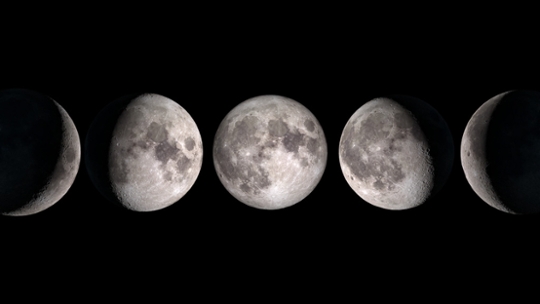
September's full moon phase occurs at, at 12:49 p.m. EDT (1649 GMT) on Saturday, Sept. 26, when the moon shines opposite the sun in Earth's sky, appearing fully lit by its rays.
In 2026, the September full moon is also known as the Harvest Moon because it occurs closest to the autumn equinox. Traditionally, farmers would work late under the light of this moon to gather in the summer harvest before the weather turned.
|
|
|
|
Why does daylight still outlast darkness when fall begins?
|
|
|
Your guide to September's full Harvest Moon, from peak times to skywatching highlights.
|
|
|
|
Discover the 'eclipse of the century' with this comprehensive total solar eclipse 2027 guide. Find out where to see it, the timings of totality and possible weather conditions for key locations.
|
|
|
|
Geomagnetic activity really does increase around the equinoxes, but bright moonlight is arriving at exactly the wrong time for anyone hoping to catch a subtle aurora.
|
|
|
| Astronomy Kit and Accessories |
|
|
From stars and planets to galaxies and nebulas, the best telescopes will get you a great view of whatever you want to look at and with October Prime Day coming on Oct. 6, these models could get cheaper!
|
|
|
We have fully tested and ranked the best binoculars for stargazing and spotting galaxies, star clusters and planets. Models could drop in price this October Prime Day on Oct. 6.
|
|
|
| Stay up-to-date on all things space science, news, and entertainment by subscribing to our newsletters. |
|
|
|
 |
Follow Night Sky This Week |
 |
 |
 |
 |
|
|
|
|
|
|
|




No comments:
Post a Comment