
From: Skeptoid Companion Email <noreply@skeptoid.com>
Date: Tue, 10 Feb 2026 at 16:15
Subject: Skeptoid: Radioactive Relics: The Missing RTGs
To: <zvagoman@gmail.com>
 | |||
The weekly companion email provided with each new episode of the Skeptoid podcast | |||
 | |||
Skeptoid #1027: RADIOACTIVE RELICS: THE MISSING RTGS The Arctic coast of Russia is about as remote and unforgiving a place as there is. Go east from Norway and you'll follow 24,000 kilometers of coastline with countless inlets and peninsulas — from the Barents Sea to the Kara Sea to the Laptev Sea to the East Siberian Sea to the Chukchi Sea, until you reach the Bering Strait, beyond which is Alaska. Along that whole stretch are fewer settlements than you can count on the fingers of one hand. And yet shipping traffic has had to navigate the Northern Sea Route for a century, hauling millions of tons of cargo from one end to the other of the world's largest country — most of it long before the invention of satellite navigation. Shore-based radio beacons were the primary navigational aid, which raised a problem: Without even a single road along the coast, let alone a power grid, how could the radio beacons be powered? by Brian Dunning  | |||
| |||
WONDER OF THE WEEK Viking cog may be the world's largest 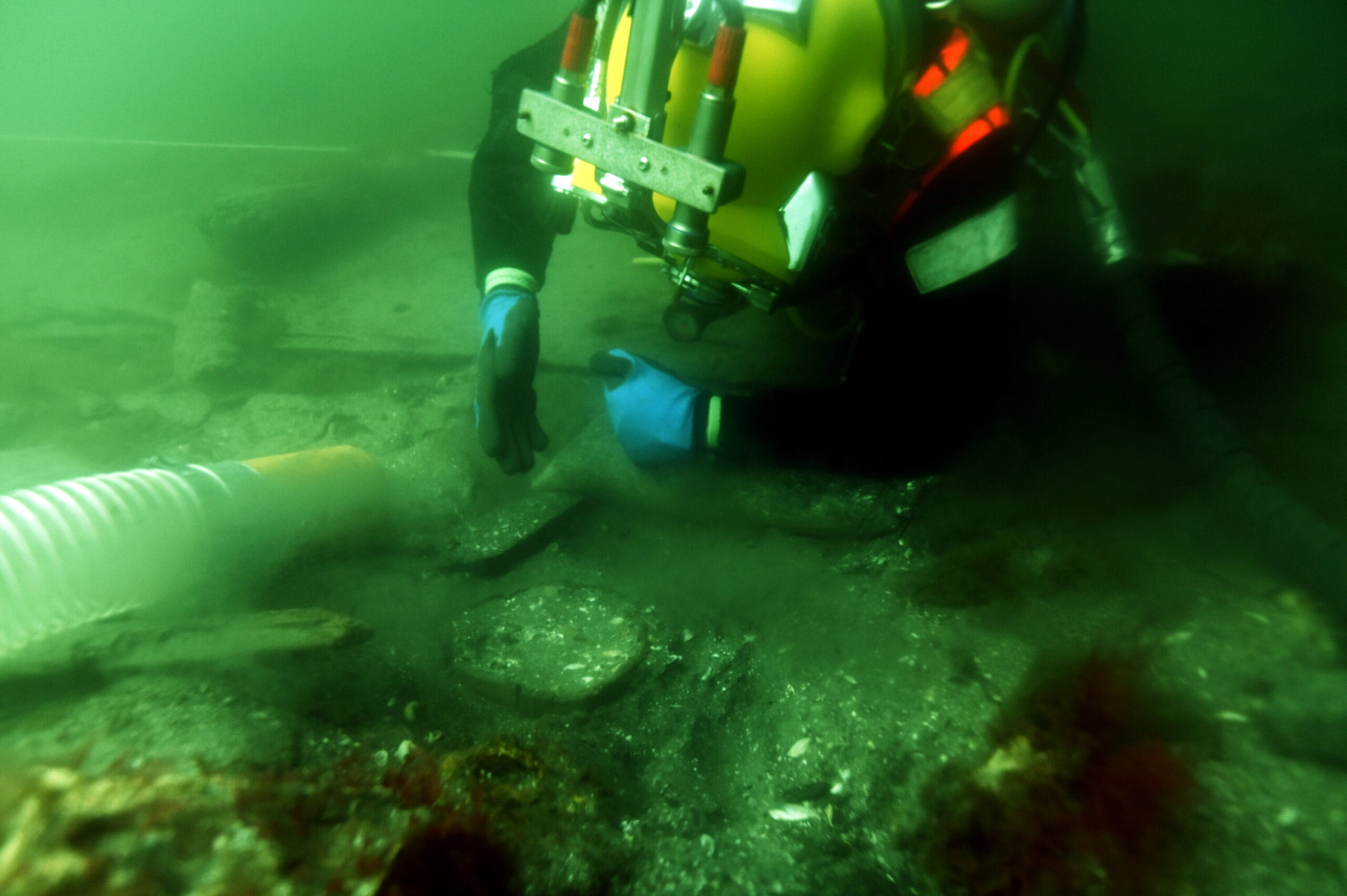 Underwater archeology on a newly discovered cog (Courtesy Viking Ship Museum) In the 14th and 15th centuries the cog was key to trade in Northern Europe. After remaining hidden in the water off of Copenhagen for 600 years, what may be the largest ever has been discovered by maritime archeologists. Excavation leader Otto Uldum sets the stage: "The cog revolutionised trade in Northern Europe. It made it possible to transport goods on a scale never seen before." The ship, built around 1410, has been named Svælget 2 after the channel where it was found, and measures 28 meters (92 feet) long, 9 meters (30 feet) wide, and 6 meters (20 feet) tall, giving it an estimated cargo capacity of 300 tons. It's not only the largest yet found, but is in the best condition. The starboard side was protected by sand from keel to gunwale, which is something never seen before in a cog find. Archeologists were even able to find traces of the ship's rigging. A distinctive feature in surviving illustrations of medieval cogs are the high castles at bow and stern. But there has never been reliable archeological evidence that these castles actually existed until now. Uldum explains, "We have plenty of drawings of castles, but they have never been found because usually only the bottom of the ship survives. This time we have the archaeological proof." Further evidence that the ship was high tech for its day is the discovery of a brick-built galley. The 200-brick structure allowed open fire, and was surrounded by cooking pots, bowls, and the remains of fish and meat. "We have never before seen a brick galley in a medieval ship find from Danish waters. It speaks of remarkable comfort and organisation on board. Now sailors could have hot meals similar to those on land, instead of the dried and cold food that previously dominated life at sea," says Uldum. So far there's no hint as to what the ship's cargo may have been. Since the hold was uncovered, things like timber, barrels of salt, or bundles of cloth would have just floated away as it sank. But all evidence points to it being a strictly merchant vessel, with no evidence of war or conflict in the ship. It's an exciting find for archeologists working to understand the technological development of medieval ships and their effect on society at the time. Uldum sums things up: "Perhaps the find does not change the story we already know about medieval trade. But it does allow us to say that it was in ships like Svælget 2 that this trade was created. We now know, undeniably, that cogs could be this large - that the ship type could be pushed to this extreme. Svælget 2 gives us a tangible piece of the puzzle and makes it possible to understand how technology and society evolved side by side in an era when shipping was the driving force behind international trade." Contributed by Craig Good. | |||
SKEPTOID COMING TO YOU... February 12, 2026 - Council Bluffs, IA February 13, 2026 - Lincoln, NE February 17, 2026 - Bend, OR I would love to come visit your group too — click here to make it happen! | |||
PLEASE DONATE TO SUPPORT SKEPTOID! People need reliable information they can count on. And at Skeptoid Media, Reliability Matters. We provide thoughtful analysis and empower our listeners to make solid decisions based on facts, not fiction, and science without sensationalism. How Can You Help? Your donations make Skeptoid Media possible! As a 501(c)(3) nonprofit, we are mission driven, not profit driven. And our organizational values underscore everything we do:
Our success -- even our very existence -- relies on your generosity. As you listen to the Skeptoid podcast and our other programming, remember that by contributing to Skeptoid Media, you truly make a difference in the world. And when you donate, you are rewarded with a premium membership! Premium members have access to the ad-free premium extended version of the show, plus we'll also thank you with a free gift, and more. Become a member today and help support reliable information and critical thinking skills across the globe, brought to you by one of your favorite, hardworking educational nonprofits. Thank you for helping Skeptoid Media thrive! | |||
100 EPISODES AGO
| |||
200 EPISODES AGO
| |||
300 EPISODES AGO
| |||
400 EPISODES AGO
| |||
500 EPISODES AGO
| |||
This email is a weekly companion to the Skeptoid Podcast. Or visit your Members Portal to manage your account and email settings
|





 © Skeptoid Media, Inc.

No comments:
Post a Comment